
This is the second part of the HyperVolatility fundamental research called “International Energy Agency’s World Energy Outlook 2025”. The International Energy Agency in its World Energy Outlook always creates different scenarios and the present fundamental research will focus on the “Current Policy Scenario”.
What is the current policy scenario? The explanation is fairly straightforward. The IEA’s current policy scenario provides a future projection about the demand of each energy source based on the policies which have been already discussed and implemented. In other words, this is the most concrete scenario which the IEA actually has in place because it is based on empirical evidence. All the energy and environmental policies have already been discussed in local governments, they have been approved and they have been already implemented.
This is the only fact-based scenario in the IEA’s World Energy Outlook. The remaining two scenarios are called “Stated Policy Scenario” (STEPS) and “Net-Zero Scenario” (NZS). The STEPS scenario includes all those energy and environmental policies which governments and politicians said they will implement, however, these policies are just statements because they are yet to be discussed in parliament, they are not approved yet and certainly they have not been implemented yet. The problem with the STEPS scenario is the fact that only a few of the stated energy and environmental policies will be discussed, approved and implemented. The NZS scenario is purely and simply the best case scenario where all environmental goals (net-zero emissions) are achieved by all countries by 2050.
As previously mentioned, the current HyperVolatility fundamental research will be focusing on the current policy scenario of the International Energy Agency’s World Energy Outlook 2025 report and will explore the projections of the idiosyncratic demand for each type of fuel all the way up to 2050. Hence, all charts and tables reported in the present research have been entirely made by the International Energy Agency
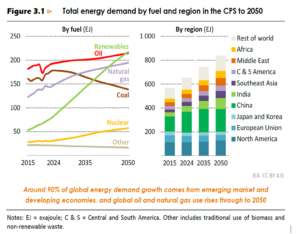
Global demand for energy is supposed to be increasing by 1.2% every year up to 2050 in the current policy scenario. However, the IEA estimated that developing and emerging economies will account for 90% of the increase in energy demand in coming years with India expanding at the fastest pace (3% every year on average), Southeast Asia at 2.4% and then Middle East (2.1%). China’s energy demand, which accounted for 50% of energy demand growth since 2000 so far, will be growing at 1.1% annually up to 2035. Conversely, growth in advanced economies is expected to annually expand by 0.15% on average.
This IEA chart shows fairly well that the society is moving from a “one-energy” world to a “multi-energy” paradigm. Technically, in exajoule terms, the energy content produced by renewables is expected to surpass the amount generated by coal around 2038, the amount generated by natural gas around 2046 and the amount generated by oil around 2050, at least in the current policy scenario. Overall, crude oil and natural gas are and continue to be at the top of the energy portfolio but by 2050 there will be also renewable sources of energy, at least in the current policy scenario. Nuclear energy increases but the energetic content created remains limited while the phasing out of coal gets accelerated by the rise of renewables. North America, China, India, European Union and Southeast Asia are the regions with the highest demand with China, North America and India leading all the rest.
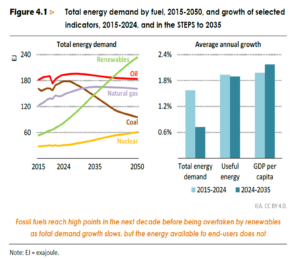
In the stated policy scenario, the rise of renewable energy is more aggressive and it takes over the amount of exajoule generated by crude oil earlier than 2050. However, the truth is that, although the stated policy scenario is more conservative on fossil fuels, the importance of crude oil, petroleum products and natural gas within the energy mix remains very high. The IEA estimates that the share of fossil fuels in total energy demand drops from 79% to 71% in 2035 which is very far from being an aggressive change, in fact, even in the stated policy scenario coal remains a valid source of energy and continues to generate more exajoule than nuclear power. Crude oil, petroleum products and natural gas, in the stated policy scenario, peak but do not decline. In fact, they tend to move sideways up to 2050 as their importance in strategic industries remain crucial. The truth is that some sectors are very difficult to electrify and this is particularly true when it comes to commercial transportation. The next IEA study highlights exactly this:
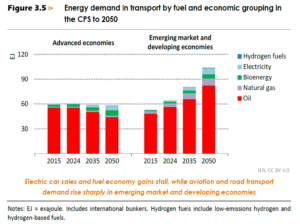
As of today, crude oil accounts for 90% of transport energy consumption and this will not change all the way to 2050. In fact, any decline in advanced economies will be more than counterbalanced by a rise in demand coming from developing and emerging countries. Advanced economies, in the current policy scenario, will experience only a sensible decline in crude oil and petroleum product consumption, however, the adoption of natural gas will massively increase in years to come and its demand will expand even more by 2050. Crude oil and natural gas are going to be the most important fuels also in developing and emerging markets, whose demand will keep rising fast, all the way up to 2050 in the current policy scenario. Crude oil, petroleum products and natural gas, in the current policy scenario, were and are going to be the most crucial types of fuel in almost every country until 2050. The next chart shows the evolution of demand in the stated policy scenario:
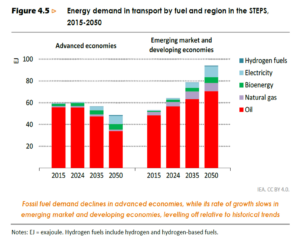
Even in this case, crude oil and natural gas remain massively important for the transportation industry all the way to 2050. Advanced economies, in the stated policy scenario, demand less oil but the difference with the current policy scenario is actually not that much. Furthermore, the natural gas consumption in this scenario is almost identical to that in the current policy scenario. Developing and emerging economies are going to experience a massive increment in energy demand but even in this case crude oil and natural gas will satisfy a large part of it. Electricity will definitely play a bigger role in the transportation sector compared to the past 20-30 years but it will continue to be only a marginal role. Furthermore, it is worth mentioning that cars are becoming heavier and bigger which means they require more energy to operate. In 2024-2025, roughly 30% of the global car fleet were composed of SUV cars which need 15% more fuel than an average car. However, the IEA found out that 95% of the SUV fleet runs on petroleum products (diesel, gasoline). All in all, even in the stated policy scenario, crude oil and natural gas dominate the transportation industry.
The transportation industry involves different segments and the passenger car fleet is an important one, however, there is another segment, as far as commercial transportation is concerned, which deserves to be taken in great consideration because it is responsible for the transportation of 88% of all commodities, raw materials and finished products in the world: shipping. Commercial shipping expanded by 30% between 2015 and 2024 but an important change began to happen over the last few years: LNG-powered ships are becoming quite common. Obviously, this has two major consequences: in the current policy scenario the share of oil within the shipping segment from 90% to 80%, nevertheless, the share of LNG rises to 15%. By 2050, the shipping industry remains mostly dependent on crude oil for bunkering because shipping activities increases by a further 45% which implies more energy will be needed to power the vessels.
Nevertheless, by 2050, in the stated policy scenario, the share of oil in the shipping sector is expected to fall to 70% of the demand while the share of natural gas/LNG along to some biofuels will be higher than 25% plus another 3% made of hydrogen, methanol and ammonia. All in all, shipping, which is the most important transportation sector in the world, will continue to rise in coming years and traditional fuels like fuel oil and its variants (LSFO, VLSFO, ULSFO) along to LNG will continue to power vessels all the way to 2050.
Key Takeaways
The key takeaways from the IEA’s World Energy Outlook 2025 are the following:
I. LNG capacity will greatly increase in the coming years
II. LNG capacity will expand in both the current and stated policy scenarios
III. Asia will be the first importer of LNG in the world, followed by Europe
IV. The vast majority of the natural gas will get delivered via LNG tankers as domestic production declines in some countries and ships are preferred to pipelines
V. IEA discarded the peak theory in the current policy scenario for both crude oil and natural gas demand
VI. In the current policy scenario, both crude oil and natural gas aggregated demand will continue to expand in advanced economies and, even more, in emerging and developing countries
VII. In the stated policy scenario, crude oil and natural gas peak around 2030 but don’t decline.
VIII. Crude oil and natural gas aggregated demand, in the stated policy scenario, remains steady up to 2050 as traditional fuels keep their strategic relevance in advanced economies and particularly in emerging and developing markets
IX. IEA highlights the dominance of crude oil and natural gas in the transportation sector. This holds true for both the current and stated policy scenarios
X. The demand for energy coming from the transportation sector will massively rise in emerging and developing economies all the way to 2050
Conclusions and final considerations
The IEA’s World Energy Outlook 2025 somehow created an earthquake within the energy and shipping community because, for the first time ever, it got rid of the peak theory for crude oil and natural gas, at least in the current policy scenario. Conversely, the stated policy scenario has a peak but there is no significant decline in the aggregated demand for traditional fuels after the peak. The demand actually remains quite steady all the way to 2050. In the stated policy scenario, despite being based on a more aggressive rise of renewable sources of energy, the global demand for coal remains relatively sustained. Specifically, the demand for coal certainly goes down in the future but the surprising fact is that even in the stated policy scenario, coal will still be used in the next 20-25 years. Clearly, getting rid of traditional fuels is challenging but it can be achieved, nevertheless, the 2050 target seems very far-fetched.
Biofuels do not generate the same amount of energy, in terms of exajoule, compared to traditional fuels and this creates multiple problems regarding the logistics, the transportation but also the space taken by biofuels on aircrafts, cars and ships. An airplane requires a lot of power but more biofuel is needed to generate the same amount of energy produced by a lower amount of jet fuel so the ratio between energy and volume favors traditional fuels. The same goes for batteries. A bulk carrier ship would need a battery so big that the only thing that the ship would be able to transport is the giant battery itself. Technological progress will certainly tackle these issues in the future but it is rather unlikely that we will manage to electrify heavy commercial vehicles like trucks, aircrafts or large vessels in the coming 20-25 years. More research will be needed to get to a point where batteries will become smaller but incredibly powerful, where biofuels can be efficiently used to power large airplanes or a massive container vessel; however, these achievements require billions worth of investments and decades of research and development.
Last but not least: taxes will rise for electricity and electric vehicles. A very important thing to mention is that the taxation for EVs and electricity is being deliberately kept at a low level but as EV and hybrid car sales go higher, the taxation will rise exactly like it happened for ICE cars, gasoline and diesel. There are a few countries (UK, France, Netherlands, Germany and some US states like Colorado) which have already adopted this policy and are now taxing electric vehicles or deleting incentives to buy or register an EV as the market becomes more mature. Hence, the limitation of buying a battery-powered car (most modern EVs have a driving range between 300 and 400 kilometers) will not just be technical (recharging car batteries usually take a few hours even if new high-power stations can do it in approximately 45 minutes) but will also become economical and this is going to slow down the switch to EVs even further.