
Refiners operate at the core of the energy industry and petroleum products are crucially important for industrial productivity and the transportation sector.
This is why this analysis will focus on how refineries operate and it will attempt to provide answers to the following research question: How can refineries optimize petroleum product production, navigate through demand/supply imbalances and hedge against price volatility?
Before diving deeper into this HyperVolatility quantitative study, it is important to mention that the present research is an update of another one called “The Crack Spread”.
Hence, the present study will expand the previous quantitative research while providing an update to the hedging strategies under examination and their performances.
The methodology of this paper at first explores the microeconomic aspects of refining and presents a classic production dilemma, subsequently shifts to market equilibrium caused by demand/supply imbalances and finally computes and analyses the hedging strategies adopted by refiners using WTI Crude, RBOB Gasoline and Heating Oil futures. The last step evaluates the efficiency of such strategies.
Refineries need crude oil to operate, therefore, they acquire it and then crack it (refine it) into different products. Consequently, their optimal hedging strategy is to secure refining margins by hedging crude oil volatility on one side while hedging petroleum product volatility on the other side of the equation: the most efficient hedging strategy to achieve this goal is a crack spread.
If we focus on the US market, the most common spreads are the 3:2:1 and the 5:3:2 cracks which involve crude oil, gasoline and heating oil (diesel). These crack spreads track very well the performances of the underlying markets despite the high volatility in fuel prices.
Crude oil and petroleum products are still the predominant energy source for several sectors ranging from industrial production to heavy transportation therefore refineries play a vital role in extracting fuels by “cracking” molecules out of different crude grades. The refining process is at the core of world’s energy production and that is why the present research will explore how refineries optimize petroleum product production, how supply imbalances can affect price and production and how to hedge against price volatility. The methodology this study will follow is fairly straightforward:
I. The first analysis will explore the microeconomic aspects of the refining industry and will study the production dilemma refiners have to solve to optimise their diesel and jet fuel output (because both fuels come from the same range of molecules so this becomes an optimisation problem to solve)
II. It will then analyse how market equilibrium can change when supply imbalances happen
III. Subsequently, WTI Crude, RBOB Gasoline and Heating Oil futures prices will be used to compute the value of two hedging strategies, often used by refineries, called cracks and their functioning will be examined
IV. The analytics will finally check if the crack strategies, despite the volatility fluctuations in energy markets, which will also be computed, still manage to efficiently track their underlying markets in order to provide an efficient cover to refining margins
The bond between crude oil prices and petroleum products have been studied several times. There are numerous papers trying to analyse the relationship among crude oil prices and its most important refining derivatives (like gasoline, diesel/heating oil, etc) from an economic, econometric and financial standpoint. Several authors pointed out that the connection between crude grades and refined products is particularly strong in both short and long terms (Asche, F., Gjølberg, O. and Völker, T., 2003) so refiners began to use this relationship to their advantage to hedge their market exposure with financial derivatives.
The US Energy Information Administration, in a very interesting report called “Derivatives and Risk Management in the Petroleum, Natural Gas, and Electricity Industries” published in 2022 stated that “derivatives are particularly useful for managing price risk” adding that “derivatives allow investors to transfer risk to others who could profit from taking the risk”. This is a remarkably crucial aspect of financial derivatives trading: refiners try to take risk away from their physical portfolios while investors attempt to get that risk profile onto their trading books because that exposure could lead to profits.
Risk does not disappear; it simply gets traded.
The simplest way for refiners to limit their risk is to enter a crack spread strategy, which allows them to lock into profits. Nevertheless, volatility in energy markets can get quite high, in fact, it is so high that stationary models do not actually work always well when applied to analyse refining margins (Población, J. and Serna, G., 2016).
Nevertheless, despite the high fluctuation rate in energy markets, refiners continue to use crack spreads to defend their profit margins because they track so well the performance of their underlying markets that can be efficiently used as inputs in energy forecasting models (Choi, H., Leatham, D.J. and Sukcharoen, K., 2015).
Crack spreads are at the core of the refining industry because refiners’ profits are intrinsically connected to crack spread performances, in fact, the relationship is linear: low crack spread values correspond to low margins and, axiomatically, low profits (Kulsen, P.J. and Kulsen, P.D., 2019). This is why refiners must constantly monitor, quantify and forecast them. A proper management in the fluctuations of crack spreads lead to a very profitable year for a refiner. Conversely, the lack of hedging strategy leads to the old proverb: “failing to plan is planning to fail”.
The first part of the present research investigates what are the most important refined products extracted from a barrel of crude oil to provide a perspective of how refineries operate.
In the second part, the research focuses on the prisoner’s dilemma refiners face when producing middle distillate products (particularly diesel and jet fuel) and on the supply/demand imbalances in the petroleum product market. Since refineries are on the supply side, the present research will analyse what happens when supply crunches occur.
The 3rd part introduces the energy market data that will be analysed: WTI Crude, RBOB Gasoline and Heating Oil futures. The time series used consists of daily prices ranging from the 1st of May 2020 to the 11th of November 2024. All futures prices are from the Chicago Mercantile Exchange (CME).
The 4th part computes the value of Crack 3:2:1 and Crack 5:3:2 and analyses the results. The formulas to compute the value of the aforementioned cracks are the following (please note that all crack values are in US dollars):

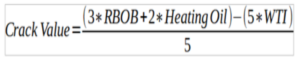
The 5th part computes the variance in the market applying the historical volatility model on the computation of log-normal returns.
The 6th part computes the correlation matrix for all energy markets (WTI Crude, Heating Oil and RBOB Gasoline) and studies the findings.
Before beginning to explore what are the most commonly produced “barrel cuts”, it is important to point out that not all refiners are equal. Big and sophisticated refineries, like the ones in the Houston area (Texas) are equipped to crack very heavy, carbon-intense crude grades, several European refineries, instead, tend to be more focused on lighter crude grades while Asian refineries might be a combination of heavy, medium-heavy, light and very light crude grades depending on their geographical locations.
It is important to point out that numerous Asian refineries are developing fast and are building more sophisticated crackers capable of processing heavy and sour grades. This is expanding the existing shipping flow as more VLCCs are transporting heavy crude grades to Asia. The difference among countries, however, is not just in their refining capacity, it also has to do with the predominance of a type of fuel in a specific region.
For example, most of passenger cars in USA are gasoline powered while in Europe and Asia diesel is the most common transportation fuel. This introduction is important because it highlights that the final refinery output could inevitably be different among regions. Nevertheless, at least on average, several refiners tend to gravitate around similar production yields.
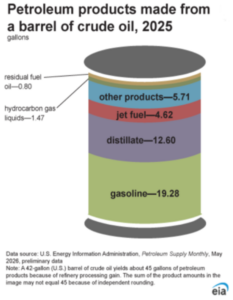
The product cut in 2025, according to the US Energy Information Administration (EIA) was the following: the average US refinery output in 2025 was around 19.28 gallons of gasoline, 12.60 of middle distillates (diesel, heating oil, kerosene), 4.62 of jet fuel (which also belongs to the middle distillate category) plus several other products (like bunker fuel, residual fuel oils, petroleum waxes, naphtha, petroleum gases, etc).
The full product list is long, however, most refiners make a significant amount of their profits from two categories only: gasoline and middle distillates (where diesel is the largest share). Given the importance these two categories have for global refiners, they tend to hedge them much more frequently. Hedging is the process of filtering out unwanted market volatility in order to make sure the selling price of each “barrel cut” gets locked in.
The reason why hedging is so incredibly crucial, not only for refiners but for every firm operating in volatile markets like commodities or shipping, is that it stabilizes cash flow streams. Companies that engage in hedging tend to “enjoy” more solid cash flows from their trading activities. This makes their operating profits steadier which, in turn, attracts more investments because hedging strategies decrease the stock’s beta of a company with respect to the rest of competitors which is something distinctly appealing to investors; particularly long-term ones who are constantly on the hunt for companies providing reliably steady returns.
Hedging filters out market noise and company earnings become inevitably more stable.
Effective hedging strategies can be difficult to implement because market volatility may be incredibly high and there usually are several factors driving it: demand/supply dynamics, over/under crude productions, overall performance of the global economy, geopolitical risk, etc. Refinery hedging involves the use of financial derivatives like futures and options to cover two complementary types of market risks: downside and upside risks.
The business model of a refinery consists in purchasing crude oil grades and selling petroleum products, which axiomatically infers that refiners have an upside exposure to the crude oil market and a downside exposure to petroleum products. If crude oil prices rise, refiners would have to pay more for the same quantity but if gasoline/diesel/jet fuel/bunker fuel prices drop, refiners would have to sell the same quantity for a lower price.
Both upside and downside risks squeeze refining profit margins and, if not properly hedged, can force companies to file for bankruptcy. Hedging is therefore an essential business practice. However, before getting to hedging, refiners have to understand what output makes the most economic sense to produce given the market conditions and the amount of molecules they have.
This is a problem they face at every level (light, middle and heavy distillate products) but middle distillate product optimization tends to be one the most common issues to solve. There are, in fact, two predominant fuels that compete for the same molecules with an equivalent amount of carbon atoms: diesel and jet fuel.
If all refiners produced more diesel than jet, ceteris paribus, they could win a larger market share but they could cause a glut in the market which would inevitably result in a price drop. Conversely, if they all produced too little, they would push prices higher and have bigger profits in the very short-term. However, they would also run the risk to eventually bring prices to a level where demand erosion would start to deteriorate profits. This is a classic case of prisoner’s dilemma.
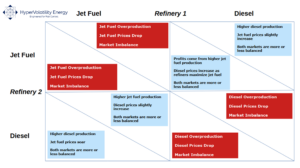
It is crucial to note that refineries, by maximizing the production of diesel or jet fuel, have a considerable impact on the demand/supply dynamics of local markets, hence, the dilemma is more regionalised rather than global.
For example, a lot of the jet fuel that arrives at the J.F.K. international airport in New York actually comes from crude oil extracted and refined in the Permian Basin in Texas (in fact, it’s called US Gulf Coast Jet Fuel). Jet fuel travels all the way from Texas to the US Northeastern Coast via the Colonial Pipeline so Texas-based refineries could impact the supply, and indirectly the price, of jet fuel in the US East Coast if they all decided to increase their production in order to win a larger market share.
There might be cases where large and important refineries could severely alter prices in bigger markets but these cases are usually caused by unforeseen technical problems or extreme weather conditions. Weather-related emergencies, in the refining industry, make for a classic microeconomic case of force-majeure-triggered equilibrium shift.
For example, many southern States in the US, including Texas, are regularly hit by hurricanes at the beginning of the Autumn season. Sometimes, these hurricanes become very powerful and several refineries are forced to go offline. This creates a market imbalance. Since the largest part of the US demand for diesel and, in particular, jet fuel comes from the northern part of the US East Coast, which doesn’t get hit by hurricanes as regularly as Texas or Florida do, the market equilibrium can get severely altered in the short-term.
In fact, when hurricanes hit Southern States, the demand does not substantially change much. However, given the fact that most of the crude oil refining happens in Texas, the supply curve may aggressively shift to the left causing a spike in both diesel and jet fuel prices.
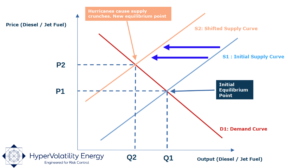
Nevertheless, this equilibrium lasts only in the short-term. In fact, the US East Coast demand, if the emergency persists, gets temporarily satisfied by Europe because US-based companies would start purchasing diesel and jet fuel cargoes with vessels departing from both Northern European ports (like Rotterdam or Antwerp) and the Mediterranean (Piraeus, Athens).
This would initially cause European middle distillate prices to move higher, since these are rival goods and their reduced availability would cause temporary shortages in Europe, but in the medium-term the fuels shipped via European vessels would re-balance the US market. This, in turn, would force the US supply curve to shift back down and prices would move back to their original equilibrium point. Once US-based refineries get back online, the European supply curve would also shift back.
At this point both European and North American markets would be back to their original equilibrium points. It is interesting to note that since the hurricane season happens every year in the US, these emergency-driven, sudden shifts in the supply curve occur more frequently than one might expect.
After solving their prisoner’s dilemma and, potentially, taking care of short-term demand/supply disequilibrium, refineries need to actually enter a position in the financial market and hedge their exposure. Since refiners handle several products but the vast majority of their profits come from the sales of gasoline and diesel, the most popular hedging strategies usually involve only two or three energy markets.
The present HyperVolatility quantitative research will examine two of the most common hedging strategies in energy markets, particularly in the USA: the 3:2:1 crack and the 5:3:2 crack. Please note that the terms “crack” or “crack spread” are commonly used within the energy industry to indicate any spreads between crude oil and one or multiple petroleum products (e.g. the diesel crack would be crude oil vs diesel).
Crude oil, gasoline and diesel/heating oil prices tend to be particularly correlated and, intuitively, petroleum products trade at a premium to crude grades.
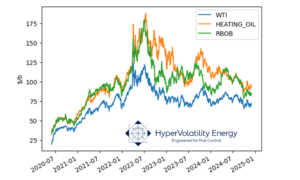
The differences among these markets visually represent refining margins or cracks. Essentially, the value of the crack is the quantification of refining margins and it is built to counterbalance the potential losses that could come from the physical sales of petroleum products in a crashing energy market or by the purchase of very expensive crude oil in an aggressively up trending energy market. Hence, the hedge is built by purchasing (going long) crude oil futures while selling (going short) diesel and gasoline.
However, since the US average refinery output, as highlighted by the EIA, is diverse and US refiners tend to produce more gasoline than diesel, hedging strategies have to reflect this difference in order to efficiently provide a cover against unwanted market risk. This is precisely why they are called 3:2:1 and 5:3:2 cracks.
The 3:2:1 crack is a strategy involving 3 WTI futures (in Europe, Brent Crude would be used), 2 RBOB Gasoline futures (RBOB is the most traded gasoline futures contract in the USA and the acronym stands for Reformulated Blendstock for Oxygenate Blending. In Europe, EuroBOB Gasoline would be used) and 1 Heating Oil futures contract (heating oil is often an umbrella term which in USA involves also diesel. In Europe, Low Sulfur Gasoil futures would be used).
The second strategy is the 5:3:2 crack, which is built with 5 WTI futures, 3 RBOB futures and 2 Heating Oil futures. It is worth noting that the 3:2:1 crack is more commonly used than the 5:3:2 because the former is traded by almost all refineries regardless of their size while the latter tends to be traded only by the largest ones (or those which have a more advanced risk management team). The present research computes the actual values of both hedging strategies and show their performances since May 2020 to November 2024.
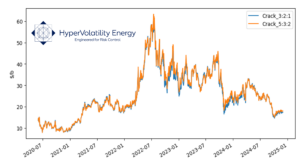
Since crude oil futures are bought while gasoline and heating oil futures are sold, the computation adds the petroleum products together while subtracting crude oil and each component is weighed according to its importance. It is quite evident that both strategies are fairly similar, fluctuate in the exact same way and substantially yield (almost) the same profits (as previously mentioned the predominant different is their size).
Refiners can trade hundreds of these structures because once the positions are entered, each refinery has the guarantee to lock in a profit. For example, if crude oil prices rise from $90/b to $100/b, refiners would gain $10/b on their long crude futures contracts but they would lose them in the physical market because they would have to materially purchase crude oil barrels at a higher price.
Nevertheless, hedging locks in prices so it becomes a zero-sum game because any loss in the physical market (in this example, refiners would spend $10 more for each purchased barrel) would be counterbalanced and offset by a gain in the financial market. This is the case of a hedging strategy built using futures contracts whose payoff is linear.
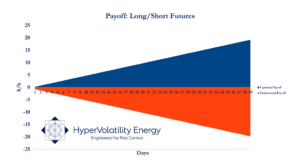
Conversely, if heating oil prices were to drop from $130/b to $110/b, refiners would lose money in the physical market, since they would be forced to sell the same quantity for a lower price, but they would make a $20/b gain on their short futures contracts effectively offsetting any loss.
This mechanism works in the opposite way should crude prices drop (as refiners would profit from the physical market) and petroleum products uptrend (profits here would come from the sales of physical barrels of gasoline, diesel, jet fuel or any other petroleum product). If the value of the crack is $20.75, it means the refiner locked in a profit which equals the value of the crack. A zero-sum game.
The loss coming from the physical market gets offset by the gains on financial derivatives and vice versa. There are cases where refiners would have to trade a reverse crack spread (selling crude oil while buying petroleum product futures) but this eventuality is particularly rare. Another way to hedge refining margins involve the use of call options and put options.
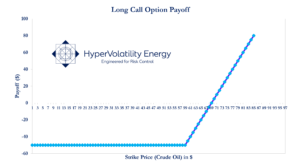
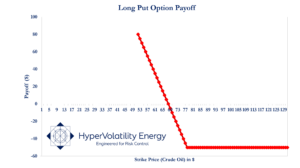
However, as both charts show, the payoffs are not linear as options contracts are non-linear financial derivatives. Hedging using only long call options or long put options is something that might help but usually refineries adopt more sophisticated options strategies which refineries use to lock into prices while limiting their risk.
Options (both calls and puts) are normally used in spreads in order to minimise the gamma risk and the bleeding of theta which derives from long gamma, long vega options positions (the most common options spreads used for hedging crude oil and petroleum products will be the topic of another research because the present HyperVolatility study focuses on delta 1 financial derivatives). Refining margins, however, are very volatile so even if refining companies are hedged, their profits remain path-dependent.
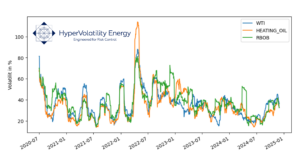
The volatility in all the studied asset classes can easily fluctuate, depending on market conditions, between 30% and 40% with peaks that in 2022 touched 80% for WTI Crude and RBOB Gasoline but managed to break through the 100% threshold for heating oil during the same period (just for reference, the largest equity index in the world, the S&P500, has an average volatility of 13%-15%).
Consequently, the overall performance of the economy determines the state of health of the demand for crude oil and petroleum products whose price fluctuations, in turn, determine the value of refining margins. The purpose of hedging is, therefore, not to eliminate all potential risks but to limit a refiner’s exposure only to those which are almost impossible to be completely hedged against (like systemic, systematic and geopolitical risks).
Hedging strategies, to be efficient, have to be closely related to markets. The following correlation matrix shows that all energy markets (WTI Crude, RBOB Gasoline and Heating Oil), between May 2020 and November 2024, have a very strong and positive correlation to both crack values.
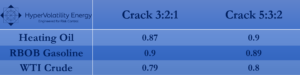
In particular, petroleum products have higher correlation coefficients than crude oil and this might be due to the fact that petroleum products tend to be less exposed to exogenous variables because their trading volume is lower than crude oil futures. This implies that despite the high volatility in energy markets, refineries can effectively implement these hedging strategies and efficiently protect their refining margins.
The analytics provided in this HyperVolatility research analysed multiple aspects of the refining business focusing on three key aspects: production optimization, supply/demand dynamics, hedging via crack strategies and efficiency of the hedging strategy. Hence, the main three findings of the present research are the following:
I. Refineries have to optimise their production and in particular that of middle distillate products. The efficient middle distillate output is achieved by studying the market equilibrium to avoid overproduction and any prisoner’s dilemma
II. The best way to structure a hedging strategy for a refiner is to place positions in the financial derivatives market and enter a 3:2:1 crack spread or a 5:3:2 crack spread involving crude oil, gasoline and heating oil/diesel markets
III. The 3:2:1 and 5:3:2 crack spreads show a high degree of correlation with their respective energy markets (WTI Crude, RBOB Gasoline, Heating Oil) despite the elevated level of market volatility in these asset classes. This makes them good hedging strategies and an accurate approximation of the true value of a physical crack spread
The present research updated and expanded the previously published HyperVolatility quantitative study called “The Crack Spread” but it will be expanded even further. The next part will explore different hedging strategies built with call and put options and will be diving deeper on the demand/supply dynamics during specific time of the year like the refinery maintenance period.